HermesX
Enterprise Agent Runtime & Multi-Tenant SaaS Control Plane
A production-grade platform for deploying, isolating, and governing AI agents at enterprise scale. Built in Go for single-binary deployment, native concurrency, and zero-dependency distribution.
Originally inspired by Nous Research's hermes-agent. HermesX has evolved into a standalone enterprise platform with multi-tenant isolation, RBAC, audit trails, sandbox execution, and SaaS-grade observability — far beyond the original agent framework's scope.
Quick Links
| SaaS Quickstart | Get a tenant up and running in minutes |
| API Reference | Full endpoint documentation |
| Architecture Overview | System design and component map |
| Configuration | All environment variables and config options |
| Deployment | Docker, Kubernetes, and bare-metal guides |
| Security Model | Threat model, RLS + FORCE RLS, sandbox, redirect bypass guard, MCP safety gates |
| RBAC Matrix | Governance roles and resource permission matrix |
| Skills Guide | Skill system user guide |
| Workflow Engine Guide | Fixed SOP workflow usage guide |
| Scheduler Guide | Distributed scheduler deployment & testing |
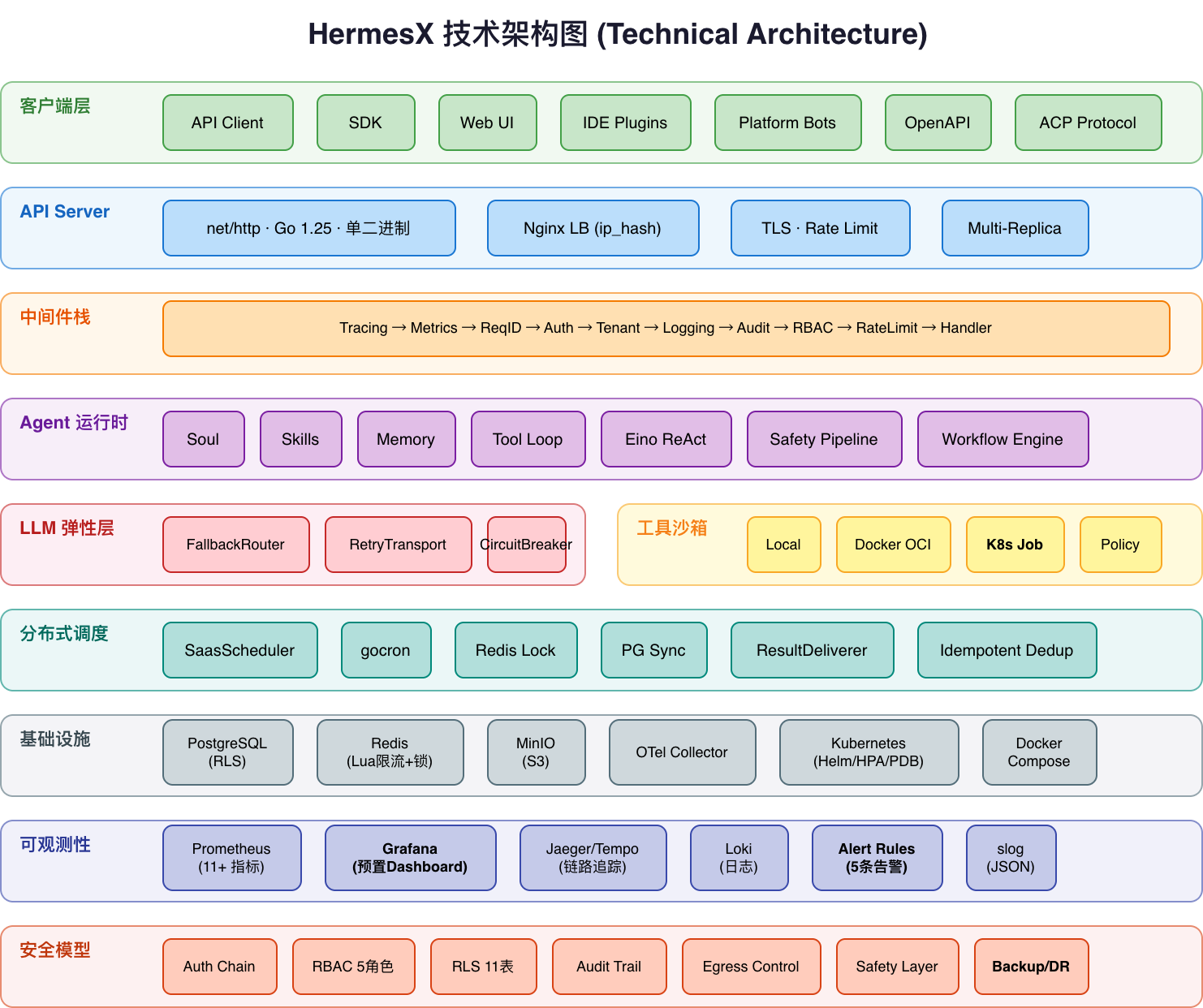
Architecture Overview
Technical Architecture
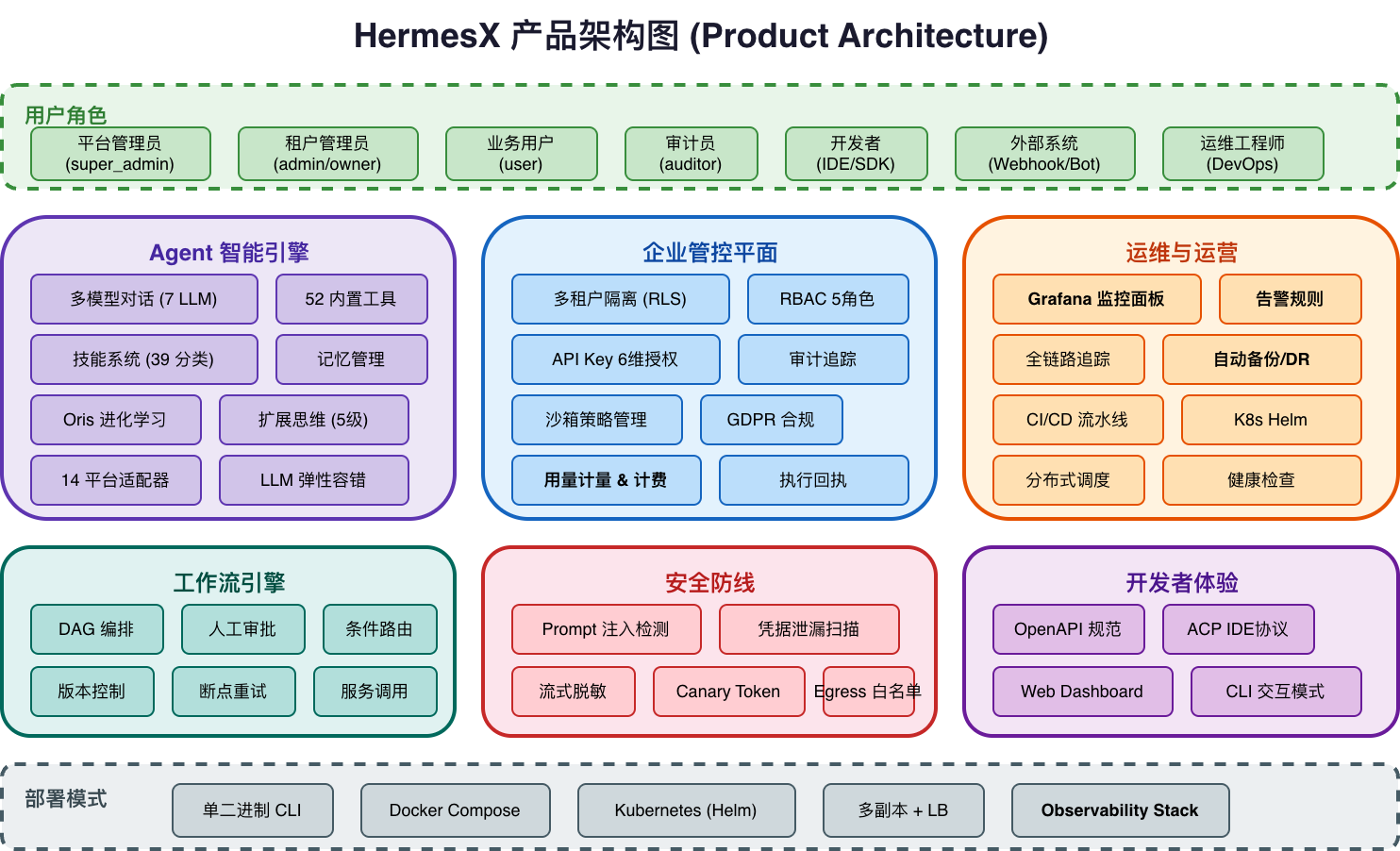
Product Architecture
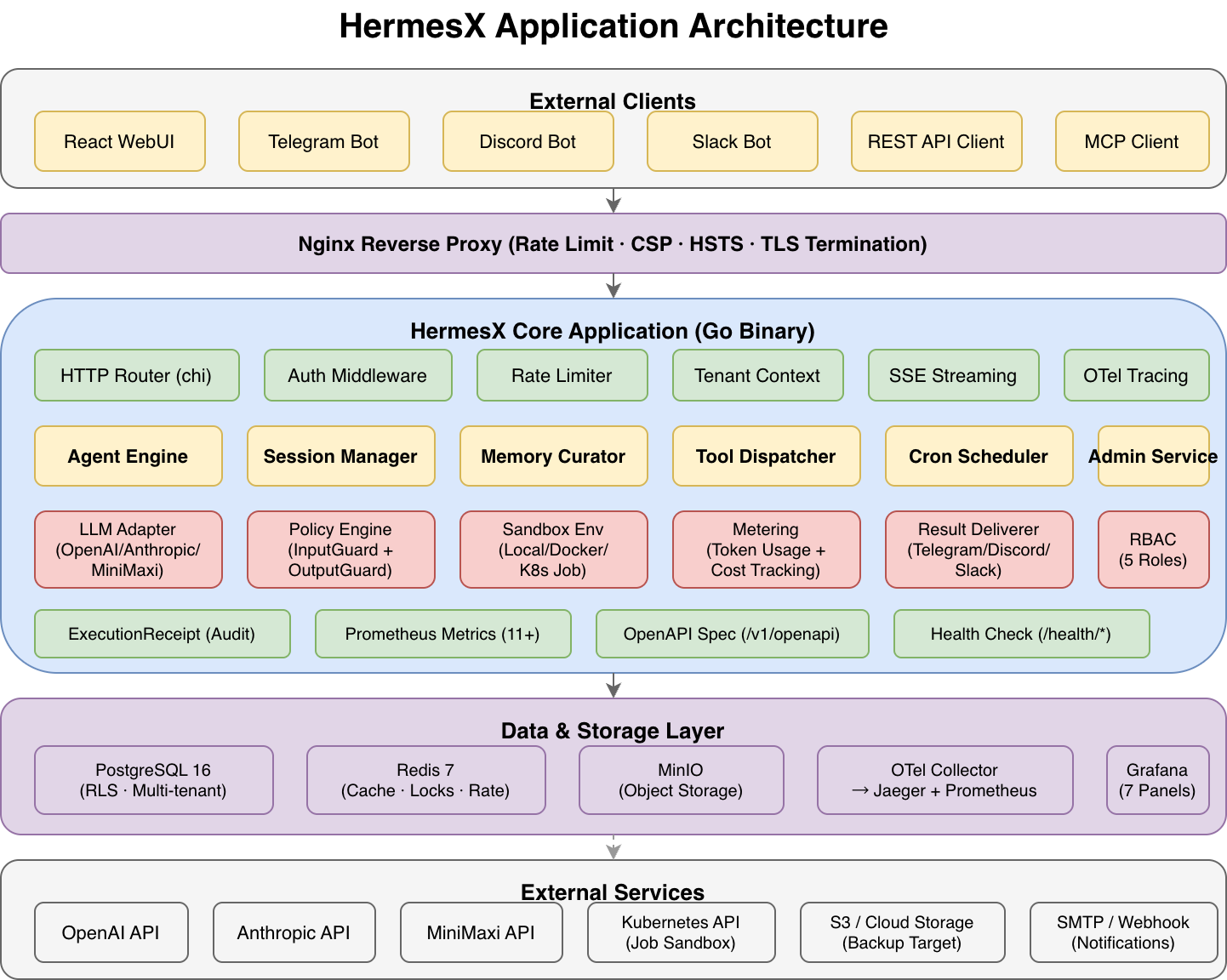
Application Architecture
Data Architecture
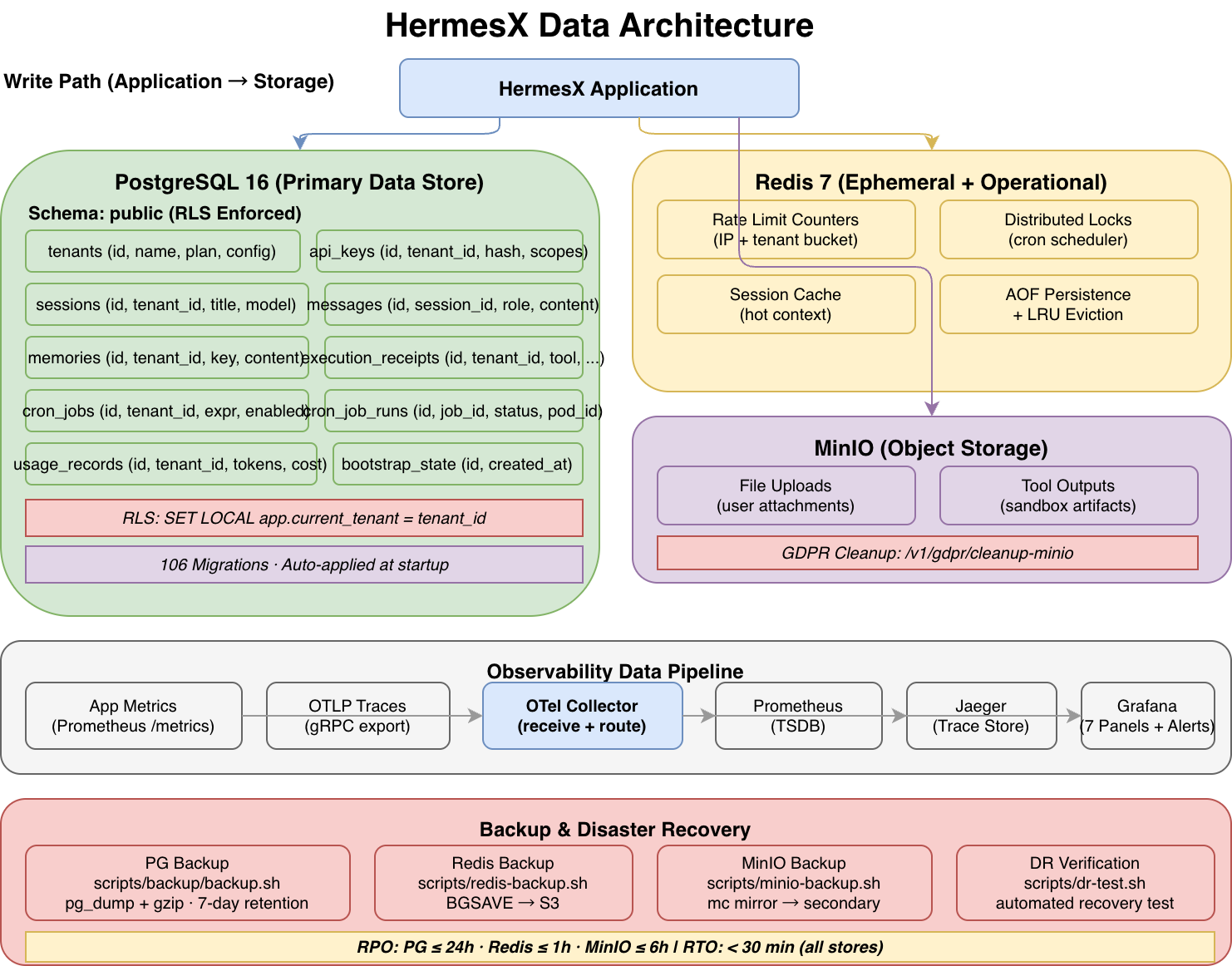
draw.io source files in
docs/diagrams/— open with draw.io or VS Code draw.io extension.
Project Stats
| Metric | Value |
|---|---|
| Go source files | 413+ |
| Lines of code | 78,000+ |
| Registered tools | 52 (42 core + 10 RL training) |
| Platform adapters | 14 |
| Terminal backends | 8 |
| LLM providers | 7 |
| Bundled skill categories | 39 directories |
| Test files | 127 |
| Total tests | 1,828 |
| RLS-protected tables | 11 |
| API endpoints | 51+ |
| Version | v2.3.0 |
Core Capabilities
Enterprise SaaS Platform
- Multi-tenant isolation — PostgreSQL Row-Level Security (RLS), per-transaction
SET LOCAL app.current_tenant, 11 RLS-protected tables (includingFORCE ROW LEVEL SECURITY) - Auth chain — Static Token → API Key (SHA-256 hashed) → JWT/OIDC, multi-level fallback
- API Key scopes —
read/write/execute/admin/audit/gdpr— six-dimensional fine-grained authorization - Governance roles — tenant, platform, security, billing, ops, owner, user, auditor, and break-glass admin roles documented in the RBAC matrix
- Dual-layer rate limiting — atomic Redis Lua script (tenant + user sliding windows), auto-fallback to local LRU when Redis is unavailable
- Token metering — async batch persistence, DB-first + hardcoded dual-layer cost calculation, supports custom pricing rules
- Execution receipts — auditable tool call records with idempotent deduplication and OpenTelemetry trace correlation
- Audit trail — immutable logs for all state-changing operations, cross-tenant queries for
super_admin - GDPR compliance — full-chain data export (JSON) + transactional deletion + MinIO object storage cleanup
- Sandbox isolation — per-tenant code execution requires an explicit
SANDBOX_MODE; production should use K8s Job, Docker is available for container isolation, and local host execution requires explicit non-production SaaS development opt-in - Bootstrap protection — bootstrap endpoint dual IP rate limiting (application layer + Nginx), cross-replica idempotent
- Distributed cron scheduling — gocron + Redis distributed lock for multi-pod scheduled task execution, PG poll-sync, idempotent dedup, SECURITY DEFINER cross-tenant cleanup, automatic result delivery to source platform
Admin API
| Endpoint | Description |
|---|---|
GET /admin/v1/bootstrap/status |
Bootstrap status (public) |
POST /admin/v1/bootstrap |
Initialize platform (ACP Token auth) |
GET/POST /admin/v1/tenants/{id}/sandbox-policy |
Sandbox policy CRUD |
DELETE /admin/v1/tenants/{id}/sandbox-policy |
Delete sandbox policy |
GET/POST /admin/v1/tenants/{id}/api-keys |
Tenant API Key management |
POST /admin/v1/tenants/{id}/api-keys/{kid}/rotate |
Rotate API Key |
DELETE /admin/v1/tenants/{id}/api-keys/{kid} |
Revoke API Key |
GET /admin/v1/pricing-rules |
Query pricing rules |
PUT/DELETE /admin/v1/pricing-rules/{model} |
Update/delete model pricing |
GET /admin/v1/audit-logs |
Cross-tenant audit logs |
GET /admin/v1/usage/tenants |
Tenant usage summary |
GET /admin/v1/usage |
Per-tenant usage aggregation (daily/monthly granularity, time range filter) |
GET/PUT /admin/v1/evolution/sharing-policy |
Global shared learning policy |
GET /admin/v1/evolution/sharing-policy/history |
Global shared learning policy history |
POST /admin/v1/evolution/sharing-policy/rollback |
Global shared learning policy rollback |
GET/PUT /admin/v1/evolution/tenants/{id}/sharing-policy |
Tenant shared learning policy |
GET /admin/v1/evolution/tenants/{id}/sharing-policy/history |
Tenant shared learning policy history |
POST /admin/v1/evolution/tenants/{id}/sharing-policy/rollback |
Tenant shared learning policy rollback |
POST /admin/v1/evolution/shared-knowledge/revoke |
Shared knowledge rollback |
Tenant API (v1)
| Endpoint | Description |
|---|---|
POST /v1/chat/completions |
OpenAI-compatible chat endpoint |
POST /v1/agent/chat |
Native agent streaming chat |
GET/POST/DELETE /v1/tenants |
Tenant management |
GET/POST/DELETE /v1/api-keys |
API Key self-service |
GET /v1/audit-logs |
Current tenant audit logs |
GET/DELETE /v1/execution-receipts/{id} |
Tool execution receipts |
GET /v1/usage |
Current tenant usage |
GET /v1/me |
Current identity info |
GET/DELETE /v1/memories/{id} |
Memory management |
GET /v1/sessions/{id} |
Session history |
GET/POST/PUT/DELETE /v1/skills/{id} |
Skill CRUD |
GET /v1/gdpr/export |
Data export (GDPR) |
DELETE /v1/gdpr/data |
Data deletion (GDPR) |
POST /v1/gdpr/cleanup-minio |
Clean up object storage |
GET/POST/PUT /v1/workflow-definitions |
Workflow definition management |
POST /v1/workflow-definitions/{id}/publish |
Publish workflow version |
POST/GET /v1/workflow-runs |
Start/query workflow instances |
GET /v1/workflow-runs/{id} |
Workflow instance details |
POST /v1/workflow-runs/{id}/cancel |
Cancel workflow instance |
POST /v1/workflow-runs/{id}/retry |
Retry paused instance |
GET /v1/workflow-tasks |
List pending human tasks |
POST /v1/workflow-tasks/{id}/complete |
Complete a human task |
GET /v1/openapi |
OpenAPI specification |
GET /health/live / GET /health/ready |
Health checks |
GET /metrics |
Prometheus metrics |
Agent Runtime
Tools (52)
Browser Automation (11)
browser_navigate · browser_snapshot · browser_click · browser_type · browser_scroll · browser_back · browser_press · browser_get_images · browser_vision · browser_console · browser_close
Supports local Playwright and Browserbase cloud backends, with visual perception (screenshot + GPT-4V analysis).
File Operations (5)
read_file · write_file · patch · search_files · file_state
file_state supports snapshot and diff tracking; patch supports unified diff format.
Terminal & Process (2)
terminal · process
Full-platform PTY support (Unix/macOS/Windows), with dangerous command detection and automatic interception.
Web (3)
web_search · web_extract · web_crawl
URL safety detection (url_safety) prevents SSRF and malicious redirects.
Vision & Media (3)
vision_analyze · image_generate · text_to_speech
Memory & Context (3)
memory · session_search · todo
memory includes a Curator for automatic deduplication (O(n) exact dedup + content similarity scan).
Skill Management (3)
skills_list · skill_view · skill_manage
Agent Collaboration (3)
delegate_task · mixture_of_agents · clarify
delegate_task runs up to 8 concurrent sub-agent goroutines; mixture_of_agents supports multi-model ensemble voting.
Code Execution (1)
execute_code — sandboxed execution (Python/Bash). When SANDBOX_MODE is unset it refuses execution instead of falling back to the host; production should use k8s-job, and docker is available for container isolation. local is limited to non-production SaaS development with HERMESX_ALLOW_LOCAL_SANDBOX=true.
Platform Messaging (3)
send_message · discord_send · discord_search
Smart Home (4)
ha_list_entities · ha_get_state · ha_list_services · ha_call_service
Scheduled Tasks (1)
cronjob — supports cron expressions, persistent scheduling, multi-tenant isolation.
RL Training (10, extended)
rl_list_environments · rl_select_environment · rl_get_current_config · rl_edit_config · rl_start_training · rl_check_status · rl_stop_training · rl_get_results · rl_list_runs · rl_test_inference
Platform Adapters (14)
| Platform | Description |
|---|---|
| Telegram | Bot API with file & media support |
| Discord | Bot Gateway with channel search |
| Slack | Socket Mode / Webhook |
| Cloud API | |
| Signal | Signal CLI |
| SMTP/IMAP | |
| Matrix | Element protocol |
| Mattermost | REST API |
| DingTalk | DingTalk robot |
| Feishu | Feishu robot |
| WeCom | WeCom application |
| Weixin | WeChat Official Account |
| DMwork | Enterprise IM |
| API Server | HTTP Webhook mode |
LLM Providers (7)
| Provider | Description |
|---|---|
| OpenAI | GPT-4o, o3, o4, etc. |
| Anthropic | Claude 4 Opus/Sonnet/Haiku with prompt caching |
| Google / Gemini | Gemini 2.5 Pro/Flash |
| OpenRouter | Unified multi-model routing |
| AWS Bedrock | Native credential chain, no key management |
| Nous Research | Inference API |
| Custom | Any OpenAI-compatible endpoint |
Supports reasoning models (Claude 3.7/Sonnet 4/Opus 4, o1/o3/o4, DeepSeek-r1, QwQ) with automatic model alias resolution (opus, sonnet, flash, r1, etc.).
Terminal Backends (8)
local (native PTY) · docker (container isolation) · ssh (remote machines) · modal (Modal cloud) · daytona (Daytona dev environments) · singularity (HPC containers) · persistent_shell (persistent shell sessions) · PTY Unix/Windows
LLM Resilience
- FallbackRouter — automatic failover to backup provider when primary LLM fails
- RetryTransport — exponential backoff retry with configurable attempts and delays
- CircuitBreaker — per-model independent circuit breaking to prevent cascading failures
Infrastructure
- Single binary — zero runtime dependencies, cross-compile to any OS/arch with
CGO_ENABLED=0 - Multi-replica ready — verified 3-replica + Nginx
ip_hashload balancer, idempotent bootstrap - Kubernetes ready — Helm chart with PDB, HPA, conservative scale-down
- Backup & recovery — PostgreSQL pgBackRest PITR (RPO < 5min, RTO < 1h) + Redis BGSAVE + S3 (RPO < 15min) + MinIO mc mirror (RPO < 1h), with automated backup scripts and disaster recovery verification (
scripts/dr-test.sh) - CI/CD — GitHub Actions (unit + integration + race detection + coverage + Docker push)
- Observability — Prometheus 11+ custom metrics, OpenTelemetry full-chain tracing (HTTP → middleware → storage → LLM), structured JSON logging (slog), pre-built Grafana dashboard (HTTP/LLM/circuit breaker/rate limits), Prometheus alert rules (5), OTel Collector config, one-click deploy via
docker-compose.observability.yml
Agent Intelligence
Oris Evolution System
Behavioral gene (Gene) learning and replay mechanism, providing an independent evolution path beyond the standard SelfImprover.
How It Works:
- Task Classification —
DetectTaskClassautomatically infers task type (debug, feature, analysis, writing, general, etc.) from the first user message and tool call history - Strategy Distillation — after conversation completion, an auxiliary LLM asynchronously distills successful behavioral patterns into a single gene (with confidence score)
- Pre-Turn Augmentation — before the next similar task begins, high-confidence strategy summaries are automatically injected, guiding the agent to reuse validated experience
- Secure Isolation — genes are stored with SHA-256-derived IDs from
tenantID + taskClass + insight, strictly isolated between tenants (preventing B2 cross-tenant contamination), sanitized for prompt injection before injection (preventing B1 injection attacks)
Storage backends: SaaS deployments use PostgreSQL or MySQL through DATABASE_DRIVER and DATABASE_URL. Genes are tenant-isolated and replayed from the API request context.
Configuration:
# SaaS environment variables / Secret
evolution:
  enabled: true
  storage_mode: "mysql"      # postgres or mysql
  min_confidence: 0.7        # genes below this threshold are not replayed
  max_genes_prompt: 3        # max strategies injected per turn
  sharing_mode: "disabled"   # disabled / anonymous / trusted
Batch Trajectory Generation
Run multiple prompts in parallel to batch-collect agent trajectory data for evaluation, fine-tuning, or RL dataset construction.
Features:
- Goroutine pool control (default 4 concurrent workers, configurable)
- Each prompt runs a full independent agent loop (including tool calls)
- Trajectories are written to tenant-isolated SaaS storage or an explicitly configured evaluation output directory
- Summary report generated (success rate, average turns, total token consumption)
Configuration:
BatchConfig{
    Prompts:       []string{"task1", "task2", ...},
    Model:         "sonnet",
    MaxWorkers:    8,
    MaxIterations: 30,
    OutputDir:     "./trajectories",
    ToolSets:      []string{"file", "terminal"},
}
Developer Tools
ACP Server (Agent Communication Protocol)
A local agent integration protocol for editors, enabling VS Code, Zed, JetBrains and other IDE plugins to interact with the agent via HTTP.
API Endpoints:
| Endpoint | Description |
|---|---|
GET /v1/health |
Service health check (public) |
POST /v1/chat |
Start agent conversation |
GET /v1/status |
Agent runtime status |
POST /v1/tool |
Direct tool invocation |
GET /v1/tools |
List available tools |
POST/GET /v1/sessions |
Session creation and listing |
GET/DELETE /v1/sessions/{id} |
Session query and deletion |
GET /v1/events?session_id=X |
SSE real-time event stream |
SSE Event Push: EventBroker maintains an independent subscription channel per session (buffered 32), pushing agent thinking, tool calls, and response events in real time.
Auth: Bearer Token (configured via ACP_TOKEN env var; empty = development mode, no auth).
Dashboard
Embedded web management UI providing visual management for sessions, configuration, skills, and gateways.
Features:
- Session list and message history viewer
- Runtime configuration viewer
- Skill list and management
- Gateway connection status
Deployment: Dashboard starts as an optional standalone module with configurable port; SPA static assets are embedded in the binary.
Auth: Write operations require Bearer Token; empty value enters development no-auth mode.
Fixed SOP Workflow Engine
Orchestrate agent tasks, HTTP service calls, and conditional branches into persistent, auditable DAG workflows with human-in-the-loop support and pause/retry semantics.
Full usage guide: Workflow Engine Guide
Node Types
| Type | Description |
|---|---|
start |
Flow entry point, completes automatically |
agent_task |
Invokes a full agent loop (Eino ReAct Graph + safety pipeline) via config.prompt |
service_task |
HTTP call to external services with custom Method/Header/Body; JSON response auto-merged into step output |
human_task |
Pauses the flow awaiting human action; resume via POST /v1/workflow-tasks/{id}/complete with outcome + variable updates |
end |
Flow exit point, completes automatically |
Graph JSON Example
{
  "nodes": [
    {"id":"start","type":"start","name":"Start"},
    {"id":"ai_check","type":"agent_task","name":"AI Review",
     "config":{"prompt":"Review compliance: {{input.description}}"}},
    {"id":"approve","type":"human_task","name":"Manager Approval",
     "config":{"assignee":"manager"}},
    {"id":"notify","type":"service_task","name":"Send Notification",
     "config":{"url":"https://api.example.com/notify","method":"POST"}},
    {"id":"end_ok","type":"end","name":"Approved"},
    {"id":"end_reject","type":"end","name":"Rejected"}
  ],
  "edges": [
    {"from":"start","to":"ai_check"},
    {"from":"ai_check","to":"approve"},
    {"from":"approve","to":"notify","condition":{"outcome":"approved"}},
    {"from":"approve","to":"end_reject","condition":{"outcome":"rejected"}},
    {"from":"notify","to":"end_ok"}
  ]
}
Conditional Routing
Edges support two-level filtering:
- Outcome matching — matches the upstream step's
outcomefield (e.g.,approved/rejected) - Condition expressions — supports
eq,ne,gt,gte,lt,lte,exists,contains,startsWith,endsWith
Path syntax: input.field, variables.key, steps.{nodeID}.output.field (supports nested dot-notation access)
Instance Lifecycle
running → waiting (awaiting human) → running → completed
                                   → paused (step failed, retryable)
                                   → cancelled
Graph Validation Rules
| Rule | Description |
|---|---|
| Exactly 1 start | No multiple or missing entry points |
| At least 1 end | Must have a termination point |
| No self-loops, acyclic (DAG) | Topological sort detection ensures flow can terminate |
| Fully connected | All nodes must be reachable from start |
Version Control
- Definitions support
draft→published→archivedstate transitions - Each publish snapshots GraphJSON; running instances are pinned to the version at launch time and never drift
Agent Safety Execution (EinoAgentExecutor)
agent_task nodes execute through EinoAgentExecutor with mandatory safety pipeline:
- Input interception — prompt injection detection
- Credential redaction — 20+ credential patterns auto-masked (AWS Key, GitHub Token, etc.)
- Iteration limit — hard cap of 50 tool loop iterations
- Stream redaction — chunk-level buffering, intermediate chunks never leak raw credentials
Storage Backends
PostgreSQL and MySQL dual implementation, tables: workflow_definitions, workflow_versions, workflow_runs, workflow_step_runs
API Quick Example
# 1. Create definition
POST /v1/workflow-definitions
{"name":"Approval Flow","graph":{"nodes":[...],"edges":[...]}}

# 2. Publish
POST /v1/workflow-definitions/{id}/publish

# 3. Start instance
POST /v1/workflow-runs
{"definition_id":"{id}","input":{"amount":10000}}

# 4. List pending human tasks
GET /v1/workflow-tasks

# 5. Complete human task
POST /v1/workflow-tasks/{stepRunID}/complete
{"outcome":"approved","output":{"comment":"Approved"},"variables":{"approved":true}}

# 6. Retry failed step
POST /v1/workflow-runs/{id}/retry

# 7. Cancel instance
POST /v1/workflow-runs/{id}/cancel
Security Enhancements
In addition to platform-level RBAC and RLS, the tool layer has multiple security detection mechanisms:
| Mechanism | File | Description |
|---|---|---|
| Credential Guard | credential_guard.go |
Detects API keys, passwords, tokens and other sensitive patterns in tool inputs/outputs, blocking credential leakage |
| Git Security | git_security.go |
Intercepts dangerous git commands (force push, history rewrite, etc.) |
| URL Safety | url_safety.go |
SSRF protection, detects internal addresses and malicious redirects |
| OSV Vulnerability Scan | osv_check.go |
Calls Google OSV API to detect known vulnerabilities in dependencies |
| Patch Parser | patch_parser.go |
Structural validation of diff content for the patch tool |
| Approval Flow | approval.go |
Human confirmation hook for dangerous operations, can integrate with external approval systems |
| Prompt Sanitization | sanitize.go (evolution) |
Cleans prompt injection patterns before evolution gene injection |
v2.3 New Capabilities (7 Architecture Enhancements)
1. Extended Thinking API
Deep reasoning for Claude models. Wires ReasoningConfig into Anthropic requests with configurable thinking budgets across 5 effort levels:
| Level | Token Budget | Use Case |
|---|---|---|
minimal |
1,024 | Simple classification, format conversion |
low |
2,048 | Standard Q&A, light reasoning |
medium |
4,096 | Multi-step reasoning, code generation (default) |
high |
10,000 | Complex architecture design, long-chain deduction |
xhigh |
32,000 | Extreme complexity, research-grade reasoning |
When enabled, max_tokens is automatically adjusted to budget_tokens + output_tokens to prevent thinking and output from competing for space.
reasoning: high # .hermes/config.yaml
2. Model Aliases
Short, human-friendly names that resolve to fully-qualified model identifiers:
| Alias | Resolves To |
|---|---|
opus |
anthropic/claude-opus-4-20250514 |
sonnet |
anthropic/claude-sonnet-4-20250514 |
haiku |
anthropic/claude-haiku-4-20250414 |
gpt4o |
openai/gpt-4o |
o3 |
openai/o3 |
flash |
google/gemini-2.5-flash |
gemini |
google/gemini-2.5-pro |
r1 |
deepseek/deepseek-r1 |
llama |
meta-llama/llama-4-maverick |
Resolution is case-insensitive with automatic whitespace trimming. Unrecognized names pass through unchanged for custom endpoint compatibility.
3. SaaS Service Config
Security by Design:
- Production configuration is injected through environment variables, Kubernetes Secrets, Compose env files, or a managed Secret Manager
- Sensitive values such as
DATABASE_URL, API keys, OIDC, MinIO, and LLM keys are not stored in the project repository - Local profile/config files are legacy internal implementation details, not public runtime interfaces
Priority (lowest to highest):
Service defaults → Environment variables / Secrets → explicit deployment overrides
4. Declarative Permission Policies
YAML-based tool access control with allow / deny / ask actions, integrated into the CheckDangerousCommand flow:
# .hermes/permissions.yaml
default: ask
rules:
  - tool: terminal
    action: deny
    commands: ["rm -rf *", "DROP TABLE*"]
    reason: "Block destructive commands"
  - tool: file_write
    action: allow
    paths: ["src/**", "tests/**"]
  - tool: browser
    action: ask
    reason: "Browser actions require human confirmation"
Loading: policies are injected through the SaaS admin API, tenant storage, or deployment configuration, and are enforced per tenant.
5. Structured Compaction
Preserves a Tool Spine — a structured summary of tool call outcomes — through context compression in long conversations:
### Tool Call History
1. terminal [ok]: go test ./... passed (127 tests)
2. file_write [ok]: success
3. grep [ok]: 15 results
4. terminal [FAIL]: exit code 1; package not found
Ensures the agent can trace "what was tried and what happened" even after heavy compression — preventing repeated failed operations or forgotten completed steps.
6. OAuth Device Flow (RFC 8628)
Standards-compliant OAuth 2.0 Device Authorization Grant for browser-based Anthropic login in headless environments:
1. CLI requests device code → Anthropic returns user_code + verification_uri
2. User opens URL in browser and enters verification code
3. CLI polls token endpoint (5s interval)
4. Receives access_token + refresh_token → persisted to tenant Secret/credential storage, with access control and rotation handled by the SaaS control plane
5. Auto-refreshes 30s before expiry
7. MCP Auto-Reconnect
Production-grade reliability for SSE-based MCP server connections:
| Parameter | Value |
|---|---|
| Heartbeat ping interval | 30 seconds |
| Initial reconnect delay | 1 second |
| Backoff factor | 2.0x |
| Max delay | 30 seconds |
| Max retries | 10 |
| Jitter range | ±25% |
After reconnection, automatically re-executes tools/list to refresh tool definitions. Prometheus metric mcp_server_reconnects_total tracks reconnections per server.
Installation
git clone https://github.com/Colin4k1024/hermesx.git
cd hermesx
docker compose -f docker-compose.prod.yml up -d
./examples/enterprise-saas-demo/demo.sh   # 11-step enterprise demo
hermesx saas-api is the only supported service entry point. The local interactive CLI, one-shot chat command, and standalone Gateway are no longer public interfaces.
See the SaaS Quickstart for a full deployment walkthrough.